×
× 




Unit 11 Tiếng Anh lớp 8 về chủ đề Science and Technology giúp học sinh tìm hiểu về những phát minh khoa học, cũng như vai trò của công nghệ trong cuộc sống hiện đại.
Trong bài viết này, IELTS LangGo sẽ cung cấp đáp án và gợi ý trả lời chi tiết cho tất cả các phần trong unit giúp học sinh nắm chắc kiến thức và vận dụng hiệu quả trong quá trình học.
Mở đầu Unit 11 là cuộc trò chuyện giữa Minh và Ann về việc học trực tuyến và các phát minh công nghệ có thể được ứng dụng vào trường học trong tương lai.
1. F - Ann and Minh had a face-to-face class yesterday.
2. T - Ann likes face-to-face classes because she can interact with her classmates.
3. F - Minh finds online classes inconvenient.
4. T - When students use 3D contact lenses, their eyes will not get tired.
5. T - Robot teachers will be able to mark papers and comment on students' work.
(1) - computer screen
(2) - 3D contact lenses
(3) - online class
(4) - robot teacher
(5) - breakout rooms
(6) - Internet connection
1. I can't see the documents on this computer screen very clearly. I need a larger one.
2. During our lessons, our teacher puts us into breakout rooms for group discussions.
3. A robot teacher in Korea teaches English to primary students.
4. We had an online class yesterday with a teacher in the US.
5. Can I wear 3D contact lenses and watch a movie too?
1. 1822: Charles Babbage invented it. Students use it to type essays and to learn online.
→ Computer
2. 1876: Alexander Graham Bell invented it. We use it to communicate with our friends and families.
→ Telephone
3. 1928: Sir Alexander Fleming discovered it. It was the world's first antibiotic.
→ Penicillin
4. 1989: Tim Berners-Lee invented it. It links information sources so everyone can access them.
→ World Wide Web (WWW)
5. 2000: Honda developed it. It can run, jump, and work as a bartender.
→ ASIMO
>> Xem chi tiết hướng dẫn giải tại đây: Tiếng Anh 8 Unit 11 Getting Started
Phần Từ vựng giúp các bạn học sinh nắm được các từ và cụm từ liên quan đến phát minh, công nghệ mới.
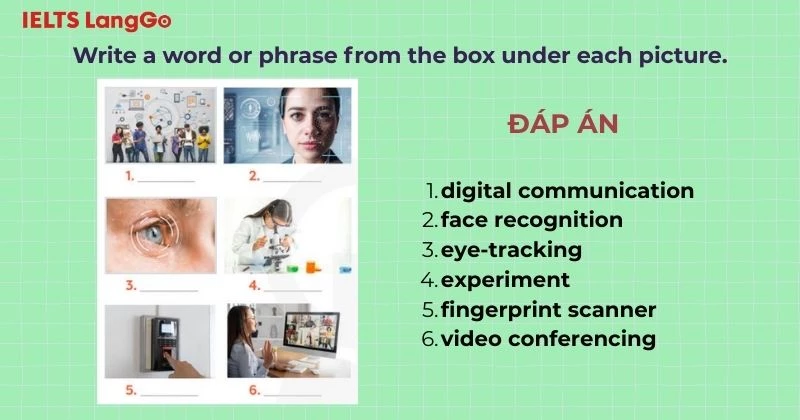
Đáp án:
Hình (1) - digital communication
Hình (2) - face recognition
Hình (3) - eye-tracking
Hình (4) - experiment
Hình (5) - fingerprint scanner
Hình (6) - video conferencing
1 - A: invent a device
2 - A: discover a chemical element
3 - B: create a medicine
4 - B: develop a technology
1. Marie Curie and Pierre Curie discovered radium and polonium.
2. Thomas Edison invented the light bulb in 1880.
3. Sarah Gilbert is the creator of a vaccine. She created it in 2020.
4. Scientists have carried out many experiments to find a cure for cancer.
5. Scan your finger on this fingerprint scanner to check attendance, please.
Phần Phát âm giúp các bạn học sinh nắm được cách nhấn mạnh vào các từ mang nội dung chính trong câu.
1. I don't have a computer.
2. Do you call her every day? – No, I don't.
3. They are not familiar with that new computer.
4. A: Did you lend her your laptop? B: Yes, I did.
5. Who do you work with on Sundays?
Đáp án:
1. He is an inventor.
→ Số lượng từ được nhấn: 1 (inventor)
2. We won't have a robot teacher next year.
→ Số lượng từ được nhấn: 5 (won't, have, robot, teacher, year)
3. She likes learning online.
→ Số lượng từ được nhấn: 3 (likes, learning, online)
4. Was she checking attendance when you came? – No, she wasn't.
→ Số lượng từ được nhấn: 6 (checking, attendance, when, came, No, wasn't)
5. What did he invent?
→ Số lượng từ được nhấn: 2 (What, invent)
>> Xem lời giải chi tiết tại đây: Tiếng Anh 8 Unit 11 A Closer Look 1
Phần bài học này tập trung giúp các bạn học sinh nắm được kiến thức về câu tường thuật dạng câu kể (Reported speech statements).
Đáp án:
1 - B: The robots will be able to mark our work.
→ My uncle said the robots would be able to mark our work.
2 - A: The robots will be able to give us feedback too.
→ My uncle said the robots would be able to give us feedback too.
1. "I am a member of the IT club."
→ Minh said that he was a member of the IT club.
2. "Mai will take an online course to improve her speaking."
→ Nam said Mai would take an online course to improve her speaking.
3. "I am talking to Phong on the phone."
→ Tom said he was talking to Phong on the phone.
4. "They are going to send me an email.”
→ He said they were going to send him an email.
5. "I don't have an iPod to listen to music."
→ She said that she didn't have an iPod to listen to music.
1. "I'm having a science test tomorrow," Mary said.
→ Mary said she was having a science test the next day.
2. "The group is working on their project now," Tom said.
→ Tom said the group was working on their project then.
3. "Mai is reading about Thomas Edison today," the teacher said.
→ The teacher said that Mai was reading about Thomas Edison that day.
4. "They will invent a smart cooker this year," my mum said.
→ My mum said that they would invent a smart cooker that year.
5. "My teacher will park her car here," said Mi.
→ Mi said her teacher would park her car there.
1. "We will live much longer in the future," said the scientist.
→ The scientist said that they would live much longer in the future.
2. "Our school is going to have a new laboratory here," said our teacher.
→ Our teacher said that our school was going to have a new laboratory there.
3. "They are developing technology to monitor students better," my dad said.
→ My dad said that they were developing technology to monitor students better.
4. "There are no classes tomorrow because our teacher is ill," Tom said.
→ Tom said that there were no classes the next day because his teacher was ill.
5. "We want some students to join the science club next semester," the teacher said.
→ The teacher said that she wanted some students to join the science club the next semester/the following semester.
Work in pairs. One student says a sentence and the other changes that sentence into reported speech. Then swap roles.
Gợi ý trả lời:
1. “My mum is a doctor.” Hoa said.
→ Hoa said that her mom was a doctor.
2. “We are doing our homework.”
→ They said that they were doing their homework.
3. “Robots can help people at home.”
→ He said that robots could help people at home.
4. “My father uses a smartphone everyday.”
→ She said that her father used a smartphone every day.
5. “We are doing a science project now.”
→ They said that they were doing a science project then.
>> Xem lời giải chi tiết tại đây: Tiếng Anh 8 Unit 11 A Closer Look 2
Phần Communication giúp học sinh làm quen với các mẫu câu thông báo tin vui (Giving and responding to good news) và thảo luận về lợi ích, hạn chế của học trực tuyến (Online Learning).
Nick: Great news for us. We'll have school clouds so we won't have to carry lots of books to school.
Mi: Great!
Nick: And I won first prize in the essay contest and got an iPad so I can read books from the school clouds.
Mi: Congratulations!
| TOPIC 1. You tell your classmate about the new vending machine at your school. |
Gợi ý hội thoại:
You: Great news! Our school has just installed a new vending machine near the canteen.
Classmate: Wow, that's great! Now we can buy drinks easily.
Hoặc:
You: Hey, great news for us! The school just put a vending machine in the hallway.
Classmate: That's great! Now we don't have to go to the canteen during break time.
| TOPIC 2. You tell your classmate about a new laptop that your dad gave you on your birthday. |
Gợi ý hội thoại:
You: My dad gave me a brand new laptop for my birthday yesterday. It's super fast!
Classmate: Congratulations! That’s wonderful.
Hoặc:
You: I've got some good news. My dad bought me a new laptop for my birthday!
Classmate: Congratulations! That's an amazing gift.
Đáp án:
| Benefits | Problems |
| 1. It’s convenient. | 1. Some students don't have computers or smartphones. |
| 2. We don't have to get up early. | 2. Poor Internet connection. |
| 3. It helps us become more independent. | 3. Eyes get tired. |
| 4. It helps us avoid traffic jams. | 4. Students can't concentrate well. |
|
| 5. Students feel stressed. |
Gợi ý trả lời về nền tảng Zoom:
We use Zoom for our online classes.
Ví dụ mẫu:
Lan said that her extra class used Microsoft Teams. She said that she and her classmates found it difficult to use. However, it is convenient to have online classes on Microsoft Teams when the weather is bad.
Gợi ý trả lời:
Sample 1:
Nick said that his class used Zoom to discuss and share ideas. He said that they interacted in breakout rooms. He also said that online learning helped them avoid traffic jams. However, he added that he was not happy about the Internet connection at times.
Sample 2:
Mi said that her teacher used Zoom to teach. She mentioned that some students didn't have computers or smartphones. She also said that others complained about the poor connection. She added that she felt more stressed when learning online.
>> Xem lời giải chi tiết tại đây: Tiếng Anh 8 Unit 11 Communication
Phần Skills 1 Unit 11 Tiếng Anh lớp 8 giúp các bạn học sinh rèn luyện 2 kỹ năng Reading và Speaking về chủ đề Science and Technology.
Đáp án:
1 - Eye-tracking
2 - Fingerprint scanner / Biometrics
3 - Face recognition
Can they be used in schools?
→ Yes, they can.
| Benefits | N/B |
| 1. It makes learning effortless. | N |
| 2. It checks students' understanding of the lessons. | B |
| 3. Students use it when they borrow books and equipment. | B |
| 4. It helps increase students' learning attention. | N |
| 5. It records students' study activities and results. | N |
1. What does checking students' attendance mean?
→ A. Checking their presence
2. With Nanolearning students can _______.
→ B. improve their learning quality
3. What DOESN'T Nanolearning do?
→ C. Entertain students
4. The texts are from _______.
→ B. advertisements
1 - c: What invention? - Biometrics
2 - a: Who invented it? - Alphonse Bertillon
3 - d: When invented? - 1800s
4 - b & e: What benefit? - Check identities of people at airports or offices & Check students' attendance
Hội thoại mẫu:
A: What invention do you like?
B: I like Biometrics.
A: Who invented it?
B: It was Alphonse Bertillon.
A: When was it invented?
B: It was invented in the 1800s.
A: What are its benefits?
B: It helps check the identities of people at airports or offices. We can also use it to check students' attendance.
Nanolearning
Báo cáo mẫu:
Nam likes Nanolearning. Junglemap created it in 2006. It's a useful learning technology. It provides small amounts of information in 2-5 minutes. This helps students increase their learning attention and makes learning effortless.
Biometrics
Báo cáo mẫu:
Mi likes biometrics. Alphonse Bertillon invented it in the 1800s. It's an important technology. We use it to check the identities of people at airports or offices and check students' attendance.
>> Xem lời giải chi tiết tại đây: Tiếng Anh 8 Unit 11 Skills 1
Phần Skills 2 Unit 11 Tiếng Anh 8 tập trung giúp các bạn học sinh rèn luyện 2 kỹ năng Listening (Nghe) và Writing (Viết) về chủ đề Khoa học và Công nghệ.
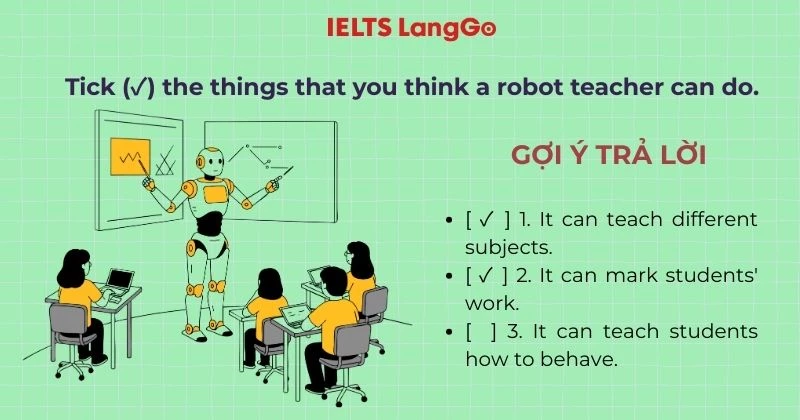
Đáp án:
[ ✓ ] 1. It can teach different subjects.
[ ✓ ] 2. It can mark students' work.
[ ] 3. It can teach students how to behave.
| Things a robot teacher CAN do | Things a robot teacher CAN'T do |
| - speak many (1) languages Minh chứng: “I heard that in Finland, a robot called Ellas can speak 23 languages.” | - teach students how to (4) behave. Minh chứng: “They can't teach students how to behave.” |
| - teach languages, (2) maths and many other subjects. Minh chứng: “This robot teaches many subjects like languages and maths to school students” | - solve (5) problems between students. Minh chứng: “One more thing is that robots can't solve problems between students…” |
| - (3) interact with students Minh chứng: “Can it interact with students? - Yes.” |
|
| Statements | T/F |
| 1. Elias can do a Gangnam style dance. | T |
| 2. Students can practise English with the robot in real time. | T |
| 3. The robot feels tired when it repeats words. | F |
| 4. The robot asks questions that are too difficult for students to answer. | F |
| 5. Robots can teach students how to behave correctly. | F |
Gợi ý các lý do:
| Agree | Disagree |
| 1. Robots can better remember things than teachers. | 1. Robots can't understand students' emotions. |
| 2. They clearly explain lessons and answer all questions. | 2. They cannot teach students how to behave. |
| 3. They never get ill or tired. | 3. They cannot inspire or motivate students like humans. |
| 4. They can work 24/7. | 4. They are expensive to buy and fix. |
Mẫu 1: Disagree
I disagree that robots will soon replace teachers at school. First, robots are machines, so they cannot understand students' emotions. They don't know when a student is sad, happy, or worried to help them. Second, robots cannot teach students how to behave. While they are good at Maths or English, they cannot teach us moral lessons or how to be a good person. Finally, robots cannot solve problems between students or inspire us like human teachers do. In conclusion, robots can support teachers, but they cannot replace them.
Mẫu 2: Agree
I agree that robots will soon replace teachers at school. First, robots can better remember things than teachers. They have access to the Internet, so they know almost everything. Second, robots never get ill or tired. They can teach all day long without complaining, and they can repeat a word many times until students understand. Third, robots can create fun lessons with videos and games instantly. I believe that with the development of AI, robots will become the main teachers in the future.
>> Xem lời giải chi tiết tại đây: Tiếng Anh 8 Unit 11 Skills 2
Phần Looking Back Unit 11 Tiếng Anh lớp 8 giúp học sinh ôn tập từ vựng về chủ đề Science and Technology và ngữ pháp về Reported speech (statements).
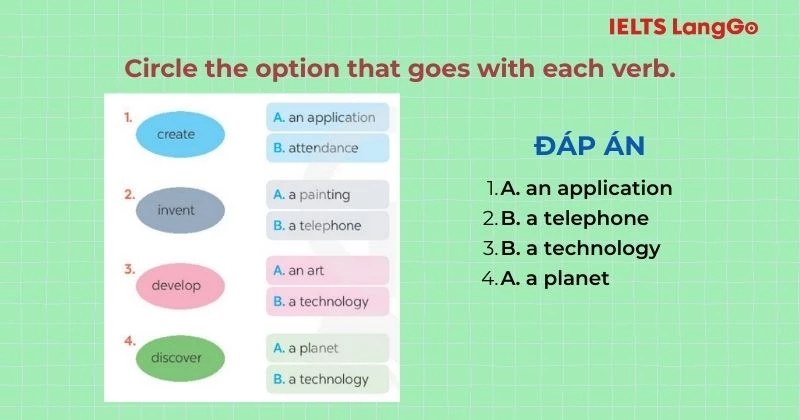
1. create ______
→ A. an application
2. invent ______
→ B. a telephone
3. develop ______
→ B. a technology
4. discover ______
→ A. a planet
Đáp án:
1. They will develop more robot teachers to support human teachers at schools.
2. Siri, the voice recognition technology, is an application of biometric technology.
3. Please look at this face recognition screen. It will check if you are a club member.
4. Teachers can ask students to wear eye-tracking glasses and check if they understand a lesson.
5. Schools can check attendance quickly and effectively using fingerprint scanners.
1. He said (A) that Isaac Newton (B) discovers gravity when an apple fell (C) on him.
→ B. discovers → discovered
2. Our teacher said that the World Wide Web (A) is a free (B) space for people (C) to share knowledge.
→ A. is → was
3. The man said (A) that Nanolearning (B) will make students' learning more (C) entertaining.
→ B. will make → would make
4. Mike (A) says that he danced (B) with an ASIMO robot (C) a day ago.
→ C. a day ago → a day before
5. The headmaster said (A) that his school (B) would use voice recognition (C) next year.
→ C. next year → the next year / the following year
Đáp án:
1. "We can't connect to the Internet to work online here," said Tom. (THERE)
→ Tom said that they couldn't connect to the Internet to work online there.
2. "Science is becoming a more important subject in schools now," Mr Thompson said. (THEN)
→ Mr Thompson said that science was becoming a more important subject in schools then.
3. "The school will use a machine to check students' attendance next year," said the headmaster. (WOULD)
→ The headmaster said that the school would use a machine to check students' attendance the next year / the following year.
4. "We are having a science competition this week," said the monitor to the class. (THAT)
→ The monitor told the class that they were having a science competition that week.
5. "We don't like robot teachers at all," said the students. (DIDN'T)
→ The students said that they didn't like robot teachers at all.
>> Xem lời giải chi tiết tại đây: Tiếng Anh 8 Unit 11 Looking back
Phần Project là bài tập nhóm giúp các bạn học sinh vận dụng các kiến thức và kỹ năng đã học trong unit thông qua một dự án thực tế về chủ đề Your Invention (Phát minh của bạn).
1. Think about a problem you have at home or at school. Imagine an invention (a tool, a machine, an application ...) that helps you deal with your problem.
2. Discuss and answer the following questions:
| What is the name of the invention? | It’s The Smart Backpack. |
| What does it look like? | It looks like a normal backpack but has a small screen and sensors inside. Let’s start with its design. The Smart Backpack has a modern look and is made of waterproof, eco-friendly material to protect your books from rain. It’s also soft and keeps you cool, making it comfortable to wear. |
| How can it help you solve the problem? | It connects to your school timetable app. If you forget a book, it will beep to alert you. It also has a "weightless mode" to make it feel lighter. |
3. Prepare a poster presentation with pictures or a paper model of the invention and present it to your class.
>> Xem bài mẫu chi tiết tại đây: Tiếng Anh 8 Unit 11 Project
Với chủ đề Science and Technology, Unit 11 Tiếng Anh lớp 8 giúp các bạn học sinh khám phá những kiến thức mới mẻ về khoa học và công nghệ, đồng thời nâng cao các kỹ năng tiếng Anh qua từng nội dung bài học.
Mong rằng phần đáp án và gợi ý trả lời từ IELTS LangGo sẽ giúp các bạn nắm vững kiến thức để vận dụng hiệu quả và đạt band điểm cao trong các bài kiểm tra.





ĐẶT LỊCH TƯ VẤN MIỄN PHÍ LỘ TRÌNH Săn ƯU ĐÃI lên tới 12.000.000đ